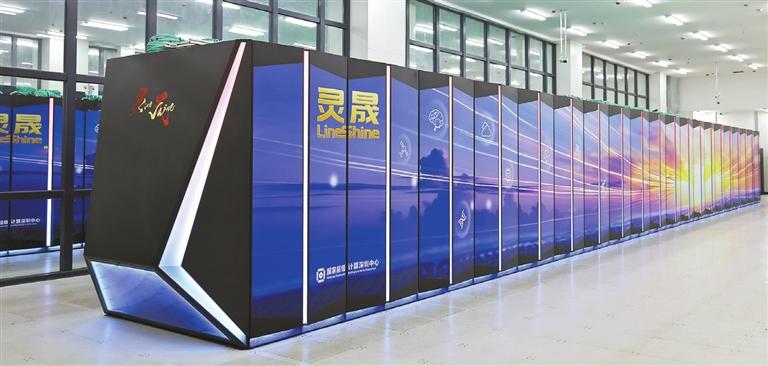
SHENZHEN-DEVELOPED supercomputer LineShine remains the world’s fastest system on the TOP500 list, according to the ranking’s 68th edition, released Monday at the SC26 conference in Chicago. Installed at the National Supercomputing Center in Shenzhen, LineShine achieved 2.198 exaflops on the High Performance Linpack benchmark. El Capitan, at Lawrence Livermore National Laboratory in California, ranked second with 1.809 exaflops. LineShine also held the top spot on the separate HPCG ranking, with a score of 22.00 petaflops. The system debuted at No. 1 on the TOP500 list in June, ending El Capitan’s run at the top. It is the first China-based system to lead the ranking since Sunway TaihuLight in 2017. The achievement marks a significant step in bringing supercomputing and intelligent computing closer together — fields that have traditionally relied on different hardware and precision requirements. Traditionally, supercomputing has relied mainly on double-precision floating-point operations for scientific applications such as physical modeling and engineering simulation, while intelligent computing has used lower-precision or integer operations for model training and inference. In recent years, the two disciplines have been moving toward integration. The conventional approach to hardware integration has been a heterogeneous CPU-GPU architecture, where the CPU handles scheduling and control while the GPU accelerates computation. However, this model suffers from high data-transfer costs, complex programming requirements and underutilized hardware resources. LineShine takes a different approach, with its pioneering “Online Acceleration” all-CPU architecture. By embedding AI matrix acceleration units directly into its domestically designed processors, the system enables CPUs to efficiently execute AI tasks without relying on GPUs, reducing the CPU-GPU data-transfer bottleneck common in heterogeneous architectures. Beyond the processor, LineShine incorporates large-scale innovations across networking, storage, system and energy efficiency. The result is a dual breakthrough in top-tier computing performance and broad real-world application deployment, providing a truly viable solution for the convergence of supercomputing and intelligent computing, said Lu Yutong, chief designer of LineShine and director of National Supercomputing Center in Shenzhen. In terms of infrastructure for scientific and engineering intelligent computing, LineShine has already supported applications in fields including atmospheric and ocean science, engineering simulation, materials science, drug discovery, brain science, scientific AI and large-model inference, according to Lei Kai, deputy director of the Shenzhen Computer Federation. (SD-Xinhua) | 