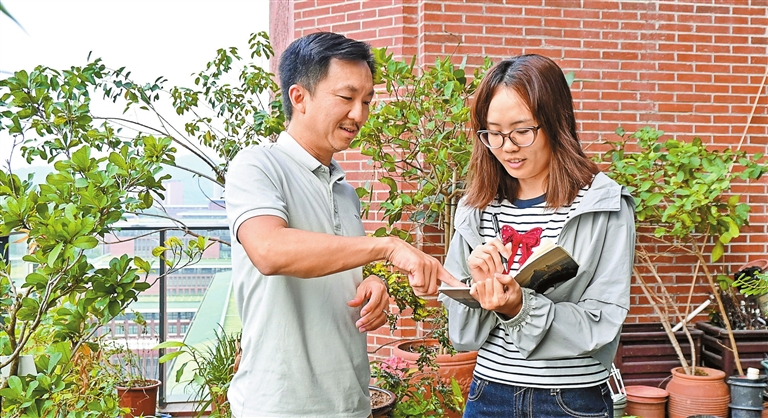
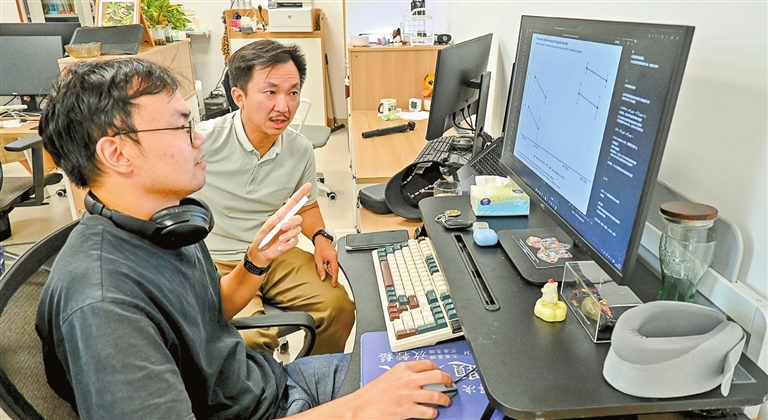
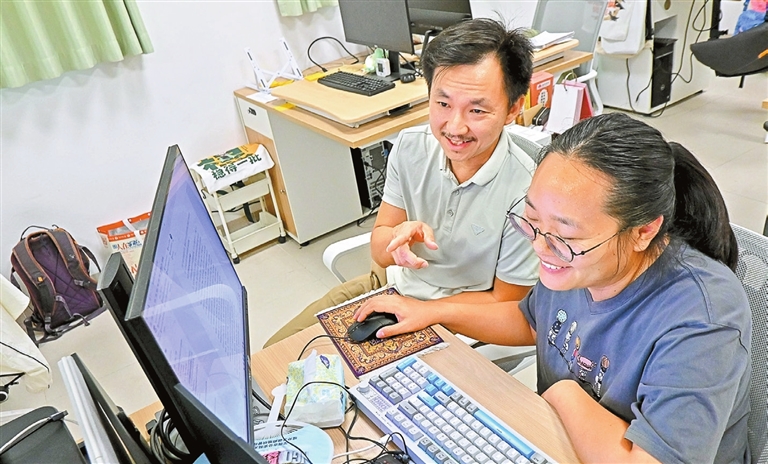
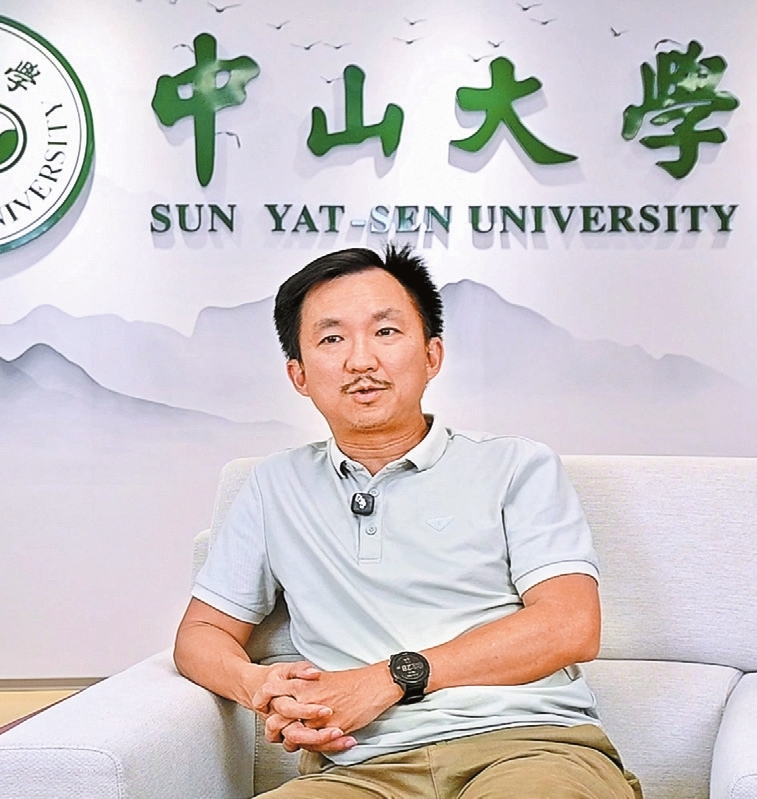
AT dawn over Shenzhen Bay, the tide lingers below and thousands of birds take flight in unison. Lee Tien-ming stands at an ecological observation post beside the mangroves, binoculars raised. The sea breeze billows his shirt. Through his lens, a black-faced spoonbill skims the water, its long beak like a black ladle. “Look, they’re back again. Every autumn, right on schedule,” Lee said, lowering the binoculars to speak of these old friends. Lee is a professor at the School of Ecology of Sun Yat-sen University in Shenzhen. He is approaching his 10th anniversary in China. Over these years, he has studied nature and society here, exploring how humans and wildlife can coexist, each making space for the other on this densely populated country. Voyaging south, coming home Lee, a Singaporean of Chinese descent born in the 1970s, traces his family roots to Putian, Fujian Province. His ancestors were among the Chinese migrants who sailed south to Southeast Asia — not the romantic journey depicted in poetry, but a grueling exodus of laborers who sent hard-earned money and letters home as remittance notes known as qiaopi. “It bears no resemblance to today’s overseas study,” Lee said. He recently watched “Dear You,” a film that left him deeply moved. “It breaks away from conventional narratives and tells the story in fresh ways. Many scenes mirror my own family’s experience.” In 1987, Lee, then a third-grader, made his first trip back to China with his grandfather. Bicycles far outnumbered cars back then. The clothes they brought were given as gifts to relatives on the mainland. That memory stays vivid: the joy on his relatives’ faces as they received the garments, and his grandfather’s quiet silhouette standing before the old family house for a long time. After that, he returned to China roughly once every decade, watching roads widen and skyscrapers rise. Lee earned his Ph.D. in the United States before completing postdoctoral fellowships at Yale, Columbia and Princeton, focusing on conservation. Like many international peers, he often hit a wall: only a small group prioritized conservation, while most communities pushed for development. That changed when he delved into China’s concept of ecological civilization. “This exploration toward a new form of human civilization beyond industrial civilization immediately captured my imagination. I could have gone back to Singapore, but this vision brought me to China.” Why Shenzhen? Shenzhen, a young city with a robust tech sector, draws much of its identity from its migrant population and remarkable openness. Nestled in the Guangdong-Hong Kong-Macao Greater Bay Area, it readily embraces new ideas and bold experiments. “Most importantly, Shenzhen dares to let you test things from zero to one,” Lee said. Many regions are constrained by regulations, entrenched mindsets and supply chain limits. Shenzhen, by contrast, opens itself to small-scale pilots for cutting-edge ideas. Teams gather data, refine safety protocols, and then scale up proven solutions. “Autonomous driving is a classic example. The same model works for ecological research.” “The city does not hand you special favors, but it leaves the path open for you to carve out,” Lee noted. He contributes to Shenzhen’s social insurance scheme and has been recognized as a national-level talent. Once a visitor dropping by every 10 years, he has grown into a genuine Shenzhen resident. Migratory birds, Asian koels and pangolins Lee’s research goes beyond trees and birds. It centers on how humans engage with nature, what he calls “Conservation 2.0.” Rather than fencing people off from protected areas, the framework uses technology to extend human perception. AI, infrared sensors, robotic dogs, drones and other tools are deployed at scale for field monitoring, made feasible by Shenzhen’s extensive manufacturing ecosystem. “Traditional surveys relied on our own eyes and feet. We trekked through mountains and often disturbed wildlife. Now sensors listen quietly in the wild, and we analyze the data remotely,” he explained. Hardware alone is not enough; public awareness, the “software” of conservation, must evolve alongside it. “This shift will not happen overnight. It may take a generation.” Lee has no laboratory on campus. His lab is the natural world. The tensions between urban development and wildlife survival in this megacity offer him a rich, living research dataset. Shenzhen Bay is a critical stopover along migratory routes. “Futian Mangrove Forest is not large, yet ecologically irreplaceable,” Lee said. It is also a beloved public recreational spot. On holidays, crowds flood the wetlands, creating immense pressure on migratory birds. “Wild animals instinctively fear humans. Heavy foot traffic alters birds’ behavior and survival patterns.” His team has rolled out a Chinese model of citizen science birdwatching, recruiting volunteers to log observations. The main challenge was volunteer burnout. Lee reworked the project design to turn participation into a self-reinforcing learning loop, weaving scattered sightings into a long-term database. Earlier this year, high-pitched calls from Asian koels disrupted Grade 12 students preparing for college entrance exams in Bao’an, sparking online debate. Koels do not build nests; they lay eggs in other birds’ nests. Their breeding season coincided with exam time, and their loud calls could be heard for kilometers. Many residents called for the birds to be chased away. Lee shared species data, ran evidence-based public outreach and mapped when and where koels appeared. “The calls are just part of their breeding cycle. It will pass soon,” he told the public. “Earplugs are recommended. Do not use poison.” Gradually, residents learned to accept the rhythm of wild creatures. “Urban space belongs not only to people, but also to a bird that returns each year.” The koels signal improving ecological health. The discovery of wild Chinese pangolins in Shenzhen surprised Lee even more. “To spot this critically endangered mammal, alongside flagship migrants like black-faced spoonbills, in such a densely populated city is a remarkable conservation win. It proves species can survive and reproduce if we reserve suitable habitats for them.” Still, Lee knows that as wildlife rebounds, new conflicts between humans and animals will keep emerging. “We must keep studying how to respond.” Forests, road runs and a taste of Southeast Asia Lee’s research stretches far beyond Shenzhen. “I take students on field trips across China. We have just returned from several sites, spending one or two weeks deep in forests and rural communities.” When he is not traveling for fieldwork, he keeps a steady routine: morning runs, analyzing data and refining models with students by day, and spending time with his children in the evening. “On weekends, I run marathons in other cities.” “I separate my professional and family roles. Life becomes draining when the two blur together,” Lee said. “Running lets me step into my own mental space. Shenzhen moves fast, but when you run, the city slows. You see where trees, birds, wind and human life meet.” Running routes are another lens through which he reads the city. “Every district in Shenzhen has its own character. Guangming grew from farmland into a science city; Futian leans toward finance, Nanshan toward innovation. There is also Hetao and Qianhai. Policies and industries evolve rapidly here. Often you do not wait for the city to adapt to you, you keep pace with it.” When homesickness hits, he seeks out a plate of Hainanese chicken rice. “Only Shenzhen serves this exact flavor, just like the version in Singapore.” That dish links his roots to his daily life. His stomach votes for nostalgia. His time votes for Shenzhen. Lee said he plans to invite international colleagues to visit. “A walk around Shenzhen Bay speaks louder than any presentation. When they see black-faced spoonbills, volunteers counting birds, and robotic dogs patrolling the hillside, they will understand what Chinese-style ecological conservation means.” “People often ask me whether Shenzhen is good,” Lee said. His answer is always simple: “Judge by how long I have stayed. Actions speak louder than words.” At dawn over Shenzhen Bay, another flock of birds lifts off above the water. Migratory birds fly south each year to rest. This “migratory bird” of a scholar has settled here for nearly a decade, and counting. (Zhang Yu) | 