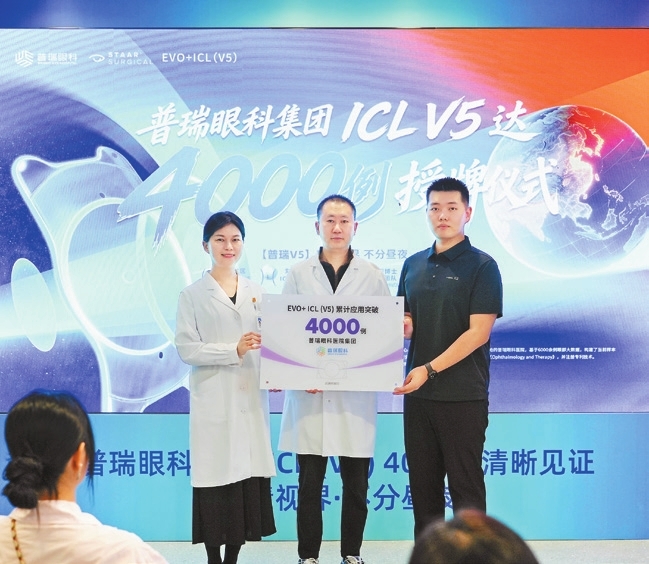
A WORKSHOP was held on Saturday afternoon at the Shenzhen branch of Bright Eye Hospital (Puri) to introduce the latest upgrade to the implantable Collamer lens (ICL), an advanced lens implant procedure that effectively treats myopia and astigmatism. The EVO+ ICL (V5) lens, produced by Switzerland-based STAAR Surgical, is an upgraded version of the ICL, designed primarily to improve nighttime visual quality by enlarging the optical zone compared with its predecessor, the V4c model. The lens utilizes the company’s proprietary Collamer material and is manufactured with Swiss precision engineering. During the workshop, Xu Yangtao, vice president of Purui’s Shenzhen branch, received official certification from a representative of STAAR Surgical, as the hospital chain has successfully performed 4,000 ICL V5 implant surgeries. The main distinction of the V5 lies in its expanded optical design, which addresses nighttime visual disturbances. Featuring an optical zone ranging from 5.0 to 6.1 mm, an increase from the V4c’s 4.9 to 5.8 mm, the V5 lens is designed to cover a wider pupil area, with a maximum effective coverage of up to 7.6 mm at the corneal plane. “In low-light conditions, the pupil naturally dilates. If the pupil exceeds the lens’s optical zone, light scattering at the edges can cause glare and halos. By covering a larger dilated pupil, the V5 is intended to reduce these visual disturbances, making it potentially more suitable for patients with large pupils or those who frequently drive at night,” said Wang Danyang, who received official recognition from STAAR Surgical as a certified surgeon to perform the operation. Beyond the optical zone, the V5 retains the core advantages of the ICL platform while introducing a refinement in precision. For myopia under 600 degrees, the V5 offers correction in 25-degree increments, compared with the 50-degree steps of the V4c. This allows for a more precise match to the patient’s actual prescription. “Unlike laser surgery, ICL implantation, an intraocular procedure, requires more complex preoperative examinations,” Wang explained. Although the procedure on one eye takes a mere 5-6 minutes, Wang said it is necessary to follow up with patients in the long term, primarily to make sure the implanted lens stays where it is placed, with a safe distance between it and the patient’s own lens. Wang also recommended that patients refrain from poor eye-use habits, such as using smartphones in the dark or lying on their side while using phones. With such bad habits, new myopia may develop, or eye strain and dry eye symptoms may worsen.(Li Dan) | 