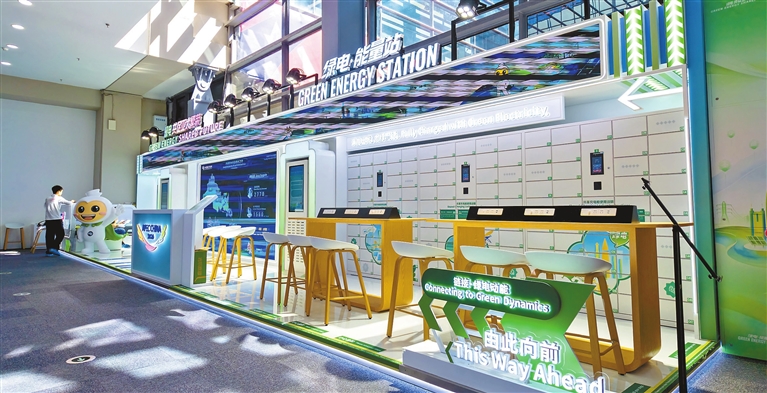
ALL venues and facilities for the ongoing APEC meetings in Shenzhen — including key venues, transportation hubs and reception sites — are running entirely on green electricity, China Southern Power Grid (CSG) said. At the green energy station in the 2026 APEC Economic Leaders’ Week Media Center at Hall 2 of the Shenzhen Convention and Exhibition Center in Futian District, a large screen displays green electricity consumption data. On Nov. 16, all APEC meeting venues used 6.06 million kilowatt-hours of green electricity, cutting carbon emissions by about 3,215 metric tons. CSG said it coordinated 89 million kilowatt-hours of green electricity in advance, drawn partly from the offshore wind base in Yangjiang, Guangdong Province, and partly from large wind and solar bases in northwest China. That means every kilowatt-hour used at the Shenzhen venues has a clear green attribute and a traceable source. “This is a window to show Shenzhen’s green and low-carbon development to the world, and an important window for the world to observe China’s power sector,” said Zou Zhiyong, general manager of marketing and customer service at CSG’s Shenzhen Power Supply Bureau (SPSB). Relying on the national unified electricity market and the west-to-east power transmission network, China can optimize and dispatch green electricity from wind, solar and hydropower across regions. The green power procured for the meeting comes from wind and solar projects in Xinjiang, Gansu and Ningxia and is delivered to the Guangdong-Hong Kong-Macao Greater Bay Area through interprovincial transmission lines, completing a “green journey” of thousands of miles. Behind the strong guarantee is integrated, full-chain service support. Faced with diverse meeting scenarios, the SPSB tailored green power supplies to different types of venues: facilities with market trading qualifications worked with the Guangzhou and Beijing power exchange centers to lock in green electricity contracts through cross-regional transactions; high-load sites such as transportation hubs are mainly supplied by clean energy including offshore wind and fishery-solar projects in Guangdong; and many reception venues without trading qualifications are covered by pre-purchased green certificates, ensuring environmental rights are fully covered and traceable throughout. In Shenzhen, green power consumption has spread to businesses, schools, hospitals, city parks and residents, reaching every corner of the city and everyday life. Residents who charge a cumulative 1,000 kilowatt-hours of green electricity at green charging stations can apply for a personal green certificate — the first green electricity consumption credential in China aimed at new energy vehicle owners. Residents can also conveniently purchase green certificates when paying their electricity bills, and each personal green certificate can be exchanged for tree-planting rights through a green public welfare mini program. Data show Shenzhen’s total green electricity trading volume has topped 52 billion kilowatt-hours, ranking among China’s top major cities in green electricity consumption. (Hu Meishi, Gao Liang, Huang Yonghua and Shen Sai) | 