
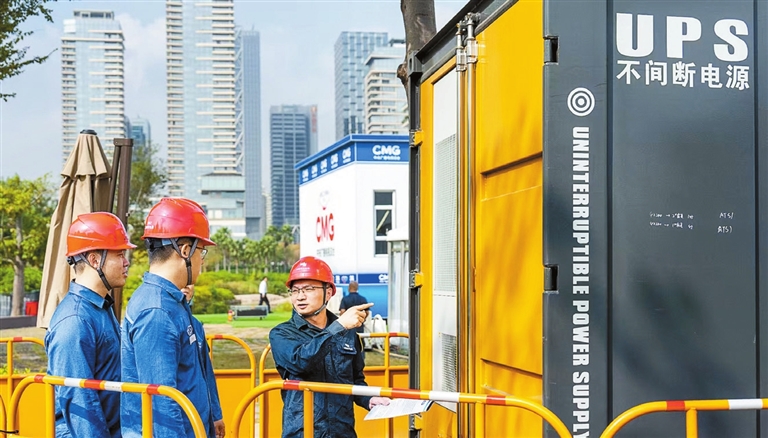
ROBOTS play the piano and throw punches on city streets. Ultra-fast chargers top up an EV in the time it takes to drink a coffee. Drones patrol transmission lines overhead. In Shenzhen, scenes once considered futuristic have become everyday life — and behind them all, power is always present. When the 33rd APEC Economic Leaders’ Meeting convened in Shenzhen on Nov. 18-19, the world’s attention turned to a city that offers a sample of Chinese-style modernization. Inside, guests gathered. Outside, the city ran like clockwork. Behind both, the grid stood watch, covering 173 key sites for Shenzhen Power Supply Bureau (SPSB), a subsidiary of China Southern Power Grid (CSG). A new architecture During preparations for the 15th National Games closing ceremony in Shenzhen in 2025, a wiring diagram was revised repeatedly, with existing and temporary lines arranged in symmetrical enclosure that bloomed into three petals resembling the bougainvillea, the city flower. The “bougainvillea wiring” became the prototype of the city’s power security technical brand. The APEC operation adopted it: six circuits in three groups, four for supply and two for backup. If one drops out, the others hold up critical demand together. Energy storage serves as a “stamen.” On Oct. 7, two grid-forming storage stations were commissioned. When mains power is interrupted, they provide voltage support within milliseconds — too fast for on-site personnel to perceive — and supply power independently for 12 hours. New technologies New technologies make the “what if” even less likely. During the APEC operation, a team worked alongside an array of intelligent equipment, letting machines do more legwork and data raise alarms first, freeing personnel to focus on analysis and response. In July, as Typhoon Nari hit neighboring Huizhou, Shenzhen felt strong winds. “Before the wind arrived, we used drones to inspect power lines; when it hit, we used video monitoring to search for foreign objects and water in cable tunnels,” said Shu Mingjie, deputy head of the digital operations team at the SPSB’s transmission management office. Tower cameras generate more than 500,000 photos a day; artificial intelligence flags suspicious points, and personnel review them. At venue endpoints, tiny sensors act as “nerve endings,” transmitting voltage, current and temperature data from each point. A unified terminal protocol lets devices from different manufacturers and batches “speak” a common language, feeding data into the smart power security system under uniform standards. On the “one map for power security,” endpoint loads are linked to upstream distribution rooms, lines and substations. When an anomaly emerges, it can be located on the map and its impact identified. A new service model New services translate grid capabilities into value users can feel: power waiting for the venue, reaching the endpoint and flowing green from the west. “The venue was still in its final stages, but the power had already been delivered,” said the project manager of the Shenzhen International Communication Center, the main venue for the APEC meeting. A cross-departmental task force resolved 12 difficult issues and advanced power delivery by half a year. The APEC meeting achieved 100% green power supply across all scenarios. ‘Six networks’ in cooperation The resilience of a megacity has never rested on a single grid alone. Water plant pumps, backup batteries at base stations, charging facilities and user-side storage were scattered across the city. Shenzhen’s virtual power plant platform connects them into a unified whole, with connected resources exceeding 5.1 million kilowatts and maximum adjustable capacity of 1.4 million kilowatts — a “backup card” that adds elasticity to grid balance. The Siming substation is exploring a “multi-station integration” model, and in Guangming District, a monitoring tower on Daniugu Mountain protects transmission lines from lightning and tracks wildfires and geological changes. When the guests depart and the cameras move on, the city keeps moving. The grid that carried a world-class summit now carries the everyday life of a megacity. The meeting is over; the power is not. (Xie Jingfan, Chen Xing, Zhu Tingting and Huang Zhanhua) | 