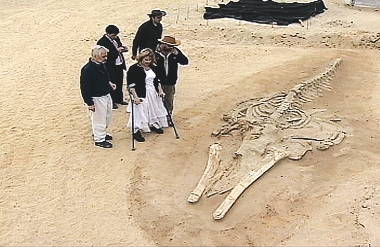
More than 2 million years ago, scores of whales gathering off the Pacific Coast of South America mysteriously met their end.
Maybe they became lost and beached themselves. Maybe they were trapped in a lagoon* by a landslide or a storm. Maybe they died there over a period of a few millennia*. But somehow, they ended up right next to one another, many just meters apart, entombed as the shallow sea floor was driven upward by geological forces and transformed into the driest place on the planet.
Today, they have emerged again atop a desert hill more than a kilometer from the surf, where researchers have begun to unearth one of the world’s best-preserved graveyards of prehistoric* whales.
Chilean scientists together with researchers from the Smithsonian Institution are studying how these whales, many of them the size of buses, ended up in the same corner of the Atacama Desert.
“That’s the top question,” said Mario Suarez, director of the Paleontological Museum in the nearby town of Caldera, about 700 kilometers north of Santiago, the Chilean capital.
Experts say other groups of prehistoric whales have been found together in Peru and Egypt, but the Chilean fossils stand out for their big number and beautifully preserved bones. More than 75 whales have been discovered so far — including more than 20 perfectly intact* skeletons.
They provide a snapshot of sea life at the time, and even include what might have been a family group: two adult whales with a juvenile* between them.
“I think they died more or less at the same time,” said Nicholas Pyenson, curator* of fossil marine mammals at the Smithsonian’s National Museum of Natural History. Pyenson and Suarez are jointly leading the research.
As for why such a great number perished in the same place, Pyenson said: “There are many ways that whales could die, and we’re still testing all those different hypotheses*.”
Pyenson said the spot was once a “lagoon-like environment” and that the whales probably died between 2 million and 7 million years ago.
(SD-Agencies)
|
