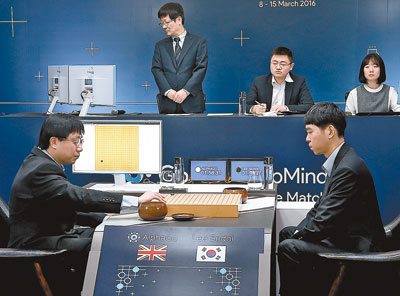
GOOGLE’S AlphaGo computer program yesterday won the first of a series of five matches against one of the world’s best players of the complex board game, Go, marking a new milestone in the development of artificial intelligence (AI).
South Korean professional Go player Lee Se-dol, an 18-time international title winner, conceded defeat in a match broadcast live, with one Youtube stream watched by tens of thousands of people worldwide, and domestic cable gave frequent updates.
AlphaGo, built by Google subsidiary DeepMind, made history in October, by becoming the first computer program ever to beat a human professional player at the ancient Asian board game.
But Lee was considered a much bigger hurdle for a machine to overcome in what many experts consider to be the most complex board game in existence.
Go, most popular in countries such as China, South Korea and Japan, involves two players moving black and white stones on a square grid with the aim of seizing the most territory.
Experts did not expect an AI program to beat a human professional for at least a decade, until AlphaGo’s victory over Fan Hui last year.
“At the beginning of the match, I never imagined I could lose,” Fan told reporters ahead of the showdown in Seoul.
AlphaGo’s ability to learn on its own in a human-like manner, key to its success, also underscores the advance of AI.
In recent years, scientists have made strides in getting computers to think and learn in ways more similar to people, with the eventual goal that AI will one day assist humans in advanced fields, such as healthcare and scientific research.
When Lee first accepted the AI challenge, he had confidently predicted a clear-cut win, saying that AlphaGo’s performance against Fan had been nowhere near good enough to defeat him.
But the grandmaster was less bullish at a press conference in Seoul on Tuesday, where he confessed to some pre-match nerves.
“Now I think I may not beat AlphaGo by such a large margin like 5-0. It’s only right that I’m a little nervous about the match,” he said. The match in the South Korean capital promises a US$1-million payout for the winner.
(SD-Agencies)
|
